 how-to
How to Sell a House in Los Angeles: A 2026 Guide
Table of Contents
- Understand Your Local Market Before Listing
- Costs of Selling a House in Los Angeles
- Prepare Your Home for Sale
- Price Your Home Strategically
- How Long Does It Take to Sell a House in Los Angeles
- How to Sell a House Quickly in Los Angeles
- Best Way to Sell a House in Los Angeles
- Close the Sale and Calculate Net Proceeds
- Frequently Asked Questions
Last Updated: October 18, 2026
Understand Your Local Market Before Listing
Before you list, know what's actually selling in your area. The market moves fast.
Homes now sit longer, so match your strategy to the current reality, not last year's market.
Check recent sales in your specific neighborhood: how long did similar homes take to sell, and what did they actually close at? We track these patterns because neighborhood-level differences matter more than citywide averages.
Costs of Selling a House in Los Angeles
Selling costs eat into your proceeds. Most sellers underestimate them. A Los Angeles selling-cost guide estimates total costs at 7% to 10% of the sale price, according to Ray Lyon Realty's 2026 selling cost guide. On a $1 million home, that's $70,000 to $100,000 leaving your pocket before closing.
Agent Commission and Transaction Fees
Agent commissions are your largest expense. Residential real estate brokers historically averaged nearly 6% of a home's closing price in sales commissions, according to research from Stanford Institute for Economic Policy Research. That's split between the listing agent and the buyer's agent, typically 3% each.
But commissions aren't fixed, they're negotiable. The question is what value you're getting for that fee.
Beyond commission, you'll pay transaction fees:
- Title insurance and title search: $300-$1,000
- Recording fees: $100-$300
- HOA transfer fees (if applicable): $50-$500
These add up fast, but they're smaller than commission. Focus your negotiation energy on the agent fee first.
Transfer Taxes and Property Tax Considerations
California has no state property transfer tax, but Los Angeles County and the city of Los Angeles both impose documentary transfer taxes on the sale price.
Los Angeles County transfer tax runs approximately 0.11% of the sale price. The city of Los Angeles adds another 0.45% for properties over $5,000.
Property tax changes at sale.
If you inherited the property, Proposition 19 may apply. It can trigger a reassessment and higher taxes.
Prepare Your Home for Sale
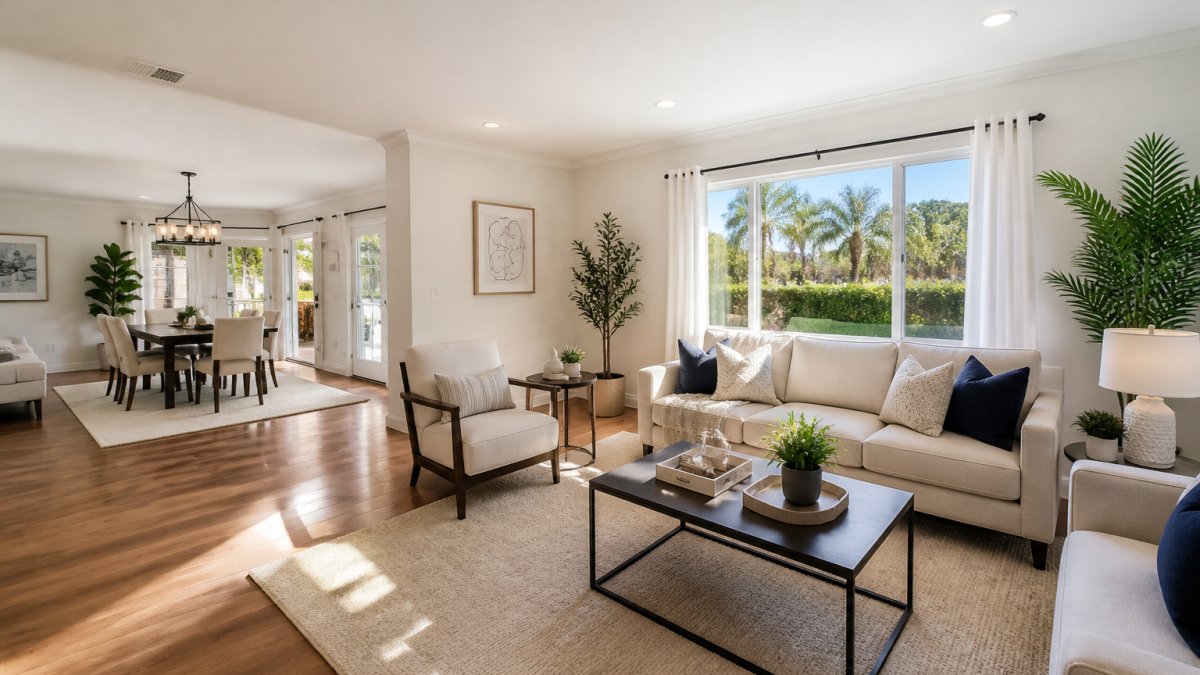
Your home's condition determines both its sale price and how fast it sells. A well-prepared home sells 20-30% faster than a neglected one.
Cleaning, Decluttering, and Staging
Start with a deep clean, not a surface clean. Buyers notice baseboards, inside cabinets and closets, grout, and light fixtures.
Decluttering comes next: remove 30-50% of your personal items so buyers imagine themselves in the space.
Professional staging costs $1,500-$5,000 but often returns 5-10% more in sale price, it helps buyers see the home's best features and imagine living there.
Key staging moves:
- Neutral paint (whites, grays, soft beiges)
- Minimal furniture to show space
- Fresh flowers or plants
- Good lighting in every room
- Clear kitchen counters
Repairs and Property Condition Assessment
Don't over-renovate, buyers will negotiate on major repairs anyway.
Get a professional home inspection before listing ($300-$500) to reveal what buyers will find. Address major issues upfront or price lower and let buyers handle repairs.
Minor cosmetic issues don't move the needle. Chipped paint, old fixtures, worn carpet, buyers expect these. Price reflects condition. Don't waste money on cosmetic fixes that won't return their cost.
Price Your Home Strategically
Pricing is the single biggest decision you make: too high and your home sits; too low and you leave money on the table.
Comparable Sales and Recent Market Data
Pull recent sales data for homes like yours: sold price (not listing price), days on market, timing, condition, and size.
According to Zillow's Los Angeles Home Values, the median home value in Los Angeles was $927,891 as of September 2026, down 0.5% year over year.
Compare homes sold in the last 30-60 days. Ignore active listings, which haven't proven their price, and sales from six months ago.
Price within 1-3% of your highest recent comp. This is your starting point. Adjust up for better condition or down if repairs are needed.
Neighborhood-Level Pricing Differences
The South Bay isn't one market. Redondo, Manhattan Beach, and Hermosa each have different buyer demand and pricing patterns.
Inventory also varies by pocket. For-sale inventory in the Los Angeles metro area increased 28% in 2024 and a further 12% in 2025, according to First Tuesday Journal's Los Angeles Housing Indicators.
Pull comps from your specific neighborhood, not the broader city. Work with an agent who knows your pocket deeply.
How Long Does It Take to Sell a House in Los Angeles
Timeline depends on market conditions, price, and how you sell, but "it depends" isn't a plan. Here's the actual sequence most sellers move through, with realistic windows for each phase so you can map your sale against your move-out date.
The Listing-to-Closing Timeline, Phase by Phase
Phase 1: Preparation (2 to 6 weeks). Sellers most often underestimate this phase.
Phase 3: Offer review and negotiation (3 to 10 days). Compare price, contingencies, financing strength, and closing timeline.
Phase 4: Escrow and contingencies (21 to 45 days). The inspection contingency typically runs 7 to 17 days, followed by appraisal and financing.
Phase 5: Closing and recording (1 to 3 days). Once contingencies are removed and the lender funds, the title company records the deed and disburses proceeds.
What Actually Moves the Timeline
- Price accuracy. The gap between a correctly priced home and an overpriced one is often 30 to 90 days of extra market time.
- Condition. Homes needing major repairs either sit longer or attract lowball offers. Fixing deal-breakers before listing compresses the timeline.
- Financing strength of the buyer. A pre-approved conventional buyer closes faster than one relying on a complex loan program with longer underwriting.
- Contingencies. Each contingency is a potential delay. Fewer contingencies generally means a faster close, though you trade some certainty for speed.
- Seasonality. Spring and early summer typically bring more buyer traffic; late fall and holiday periods slow showings and negotiations.
How Long Does It Take to Sell a House Quickly?
If speed is the priority, three levers matter most: price at or slightly below market value to generate competition and multiple offers; address the deal-breaker repairs (roof, plumbing, electrical, HVAC) so buyers don't walk or discount heavily; and invest in professional marketing so the home gets maximum showing traffic in the first two weeks. Sellers who combine all three commonly compress the active-listing phase to two to three weeks, though escrow still runs its normal 21 to 45 days.
How Long Does It Take to Sell a House As-Is?
An as-is sale, whether to a cash buyer or an investor, can close faster because it skips preparation, staging, and often the inspection contingency. The trade-off is price: as-is buyers typically discount for the repairs and risk they're absorbing. If certainty and speed matter more than top dollar, an as-is sale can close in as little as two to four weeks; if net proceeds matter more, the traditional listing path usually wins even after accounting for the extra time.
How to Sell a House Quickly in Los Angeles
Price at market value or slightly below. Homes priced 3-5% below market value attract multiple offers and sell faster, competition drives price up.
Condition matters for speed. A home needing major repairs will take longer. Buyers either walk away or lowball you. Fix the big issues first.
Marketing drives showings. Professional photos, virtual tours, and targeted advertising reach more buyers. More showings mean faster sale.
Best Way to Sell a House in Los Angeles
The best way depends on your situation. Most homeowners benefit from working with a real estate agent. Agents handle pricing, marketing, negotiations, and closing coordination. They're worth the commission if they know the market.
Marketing Your Listing and Showings
Your listing appears on multiple platforms: MLS, Zillow, Redfin, Realtor.com. But not all listings get equal attention.
Invest in professional photography. Photos are the first impression. Poor photos mean fewer showings. Professional photos cost $300-$800 but generate significantly more interest.
Virtual tours are now expected. They let buyers preview before scheduling a showing, filtering out browsers and getting serious buyers through your door.
Showings are your sales tool. Make them easy. Be flexible with timing. Keep the home clean and staged every day.
Reviewing Offers and Negotiating Terms
Offers come with contingencies. The main ones are:
- Financing contingency (buyer's mortgage approval)
- Inspection contingency (buyer's right to inspect)
- Appraisal contingency (home must appraise at offer price)
A clean offer has minimal contingencies. An offer with all three is riskier, the deal can fall apart.
Compare offers on total value, not just price. An offer at $1.05 million with no contingencies beats an offer at $1.1 million with heavy contingencies.
Negotiate terms carefully. Don't leave money on the table, but don't be so aggressive that the buyer walks.
Disclosure Requirements and Inspections
California requires extensive seller disclosures, known defects, past damage, and property history. Incomplete disclosures create legal liability.
Expect a home inspection. Buyers will find issues, some serious and some cosmetic, so prepare to negotiate repair costs: offer credits, complete repairs, or let the buyer handle them.
Inspections typically reveal 10-20 items. Most are minor. Focus on the three to five that actually matter. Don't fight over small things, it damages the deal.
Close the Sale and Calculate Net Proceeds
Closing happens 30-45 days after offer acceptance. Your title company handles most logistics. Your agent coordinates between buyer and seller.
Calculate your net proceeds before closing:
| Item | Amount |
|---|---|
| Sale Price | $1,000,000 |
| Agent Commission (5.5%) | -$55,000 |
| Transfer Taxes | -$5,600 |
| Title and Recording Fees | -$1,500 |
| Repairs/Credits | -$10,000 |
| Remaining Mortgage | -$400,000 |
| Net Proceeds | $528,000 |
This shows what you actually walk away with, which is different from sale price.
At closing, sign documents, transfer funds, and hand over keys. The title company records the deed. You're done.
Selling a house in Los Angeles requires strategy, not just hope: understand your market, price correctly, prepare your home, market aggressively, negotiate fairly, and execute the closing. Work with an agent who knows your neighborhood deeply and has a track record of getting sellers their net proceeds. Coe Real Estate Group specializes in South Bay sales, we understand neighborhood-level pricing, buyer motivation, and how to position your home for the fastest, strongest sale.
Frequently Asked Questions
What costs should I expect when selling a house in Los Angeles?
Selling costs typically range from 7% to 10% of your sale price, including agent commissions (historically averaging nearly 6%), transfer taxes, title insurance, and closing fees. For a median-priced home at $1,032,508, expect $72,000 to $103,000 in total costs. Your agent can provide an itemized estimate based on your specific property and local requirements.
How long does it take to sell a house in Los Angeles?
The timeline varies based on market conditions and your pricing strategy. With increased inventory (up 28% in 2024 and 12% in 2025), homes may take longer to sell than in previous years. Typical timelines range from 30 to 90 days from listing to closing, depending on your neighborhood, asking price, and buyer demand. A qualified agent familiar with your local market can give you a more precise estimate.
Is Los Angeles a buyer's or seller's market right now?
Current market conditions show buyer-favorable trends. Home prices declined 1.7% in September 2026 (median $1,032,508), and for-sale inventory has grown significantly in recent years. This means buyers have more options and negotiating power. However, market conditions vary by neighborhood and property type, so local analysis is essential for pricing and positioning your home competitively.
Should I sell my house as-is or make repairs first?
This depends on the extent of repairs needed and current market conditions. Minor repairs and cosmetic improvements (cleaning, staging, fresh paint) typically pay for themselves. Major structural or system repairs may be better handled by the buyer if you're in a buyer's market. A pre-sale inspection and consultation with your agent will help you decide which repairs make financial sense before listing.