 how-to
Identifying Hidden Title Defects Before Closing
Table of Contents
- Why Identifying Hidden Title Defects Before Closing Matters
- What Is a Title Search in Real Estate?
- Common Title Defects in Real Estate You Should Know
- How to Read a Title Commitment and Its Exceptions
- Your Step-by-Step Pre-Closing Title Checklist
- The Importance of Owner's Title Insurance
- Who Resolves Each Defect and How Long It Takes
- Conclusion
- Frequently Asked Questions
Last Updated: October 16, 2026
Why Identifying Hidden Title Defects Before Closing Matters
Identifying hidden title defects before closing is the step that separates a smooth purchase from a legal mess. A title defect is any claim, error, or competing interest that clouds a property's legal ownership. It can block your sale, shrink your home's value, or leave you paying for someone else's debt.
Here's the part most buyers don't hear until it's too late: title problems are not rare. Industry reporting suggests roughly a quarter of real estate transactions run into title issues that need fixing before closing, according to AmeriSave's overview of property title searches. That means the odds are real, not theoretical.
Below, we'll show you what a title search actually catches, what it misses, and how to clear problems before you sign.
What Is a Title Search in Real Estate?
A title search in real estate is a review of public records to confirm who legally owns a property and whether anything else has a claim on it. The search traces the chain of title, meaning the full ownership history, through deeds, mortgages, and court filings.
What a Title Search Covers
A standard search reviews the property records for:
- The current owner and how they took title
- The legal description and any survey discrepancies
- Recorded mortgages and prior liens
- Tax liens and judgment liens
- Easements, covenants, and other encumbrances
- Any recorded deed with a possible invalid signature
What a Title Search Can Miss
This is where buyers get overconfident. A title search only finds what was properly recorded. It cannot catch:
- An undisclosed heir with a claim to the estate
- A forged deed that looks valid on paper
- An unreleased will that surfaces later
- A boundary dispute that never made it into public records
- Fraud that hasn't been reported yet
The American Land Title Association's survey on title production complexity notes that title work is intricate and that spotting defects early is essential to issuing a policy that actually protects the buyer.
Common Title Defects in Real Estate You Should Know
Common title defects in real estate fall into two families: money problems and ownership problems. Both can stop a closing cold.
Liens and Financial Claims
A lien is a legal claim against the property used to secure a debt. If it isn't cleared, it follows the home, not the seller.
| Defect Type | What It Means | Who Clears It |
|---|---|---|
| Unpaid mortgage | Old loan never released | Seller's lender |
| Tax lien | Unpaid property or income taxes | Seller or taxing authority |
| Judgment lien | Court award against the owner | Seller |
| Mechanic's lien | Unpaid contractor or supplier | Seller |
Ownership and Chain-of-Title Problems
These are the messier ones. A break in the chain of title, an undisclosed heir, or a deed signed by someone without authority can void your ownership entirely. Forgery and fraud sit here too.
How to Read a Title Commitment and Its Exceptions
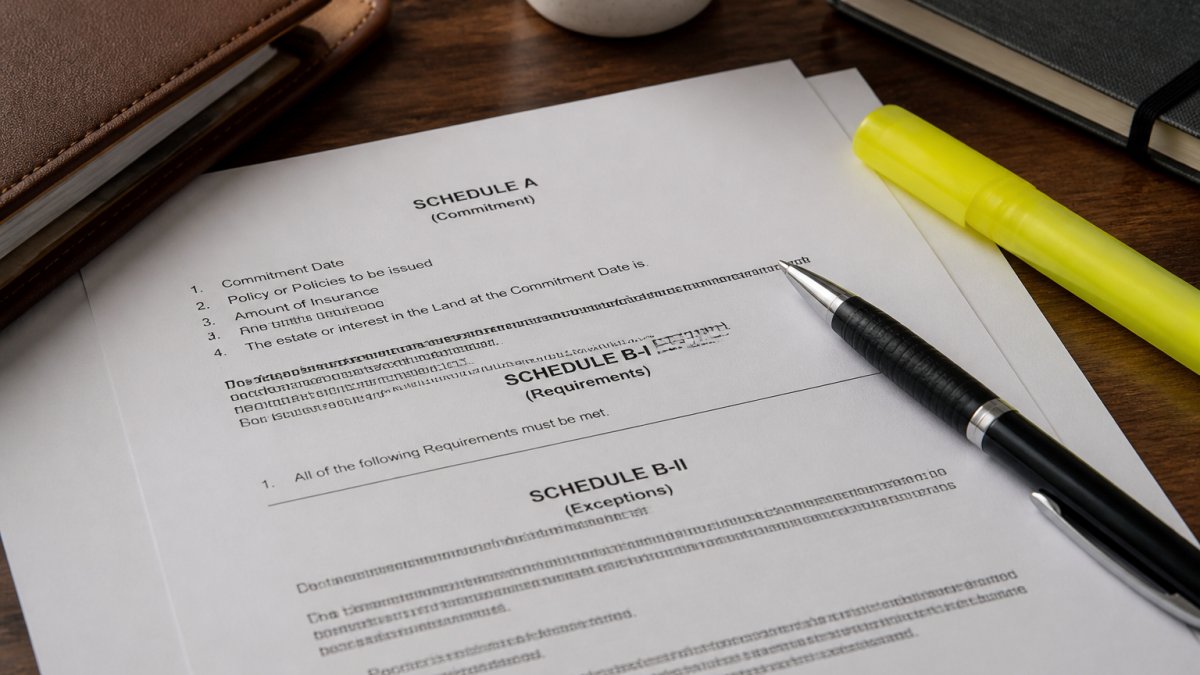
A title commitment is not a title policy. It is the title company's pre-closing promise to issue a policy if certain conditions are met. That distinction matters, because a commitment contains three distinct parts, and each one demands a different response from you.
Schedule A identifies the parties and the property: the proposed insured (usually you and your lender), the current record owner, the legal description, and the estate being transferred (fee simple, life estate, and so on). Read the legal description against your purchase contract and survey. A mismatch here, a wrong lot number, a missing metes-and-bounds call, a platted lot versus an unplatted parcel, is a defect that must be corrected before closing.
Schedule B-I lists the requirements the title company needs satisfied before it will issue the policy. Typical items include payoff and release of the seller's existing mortgage, a satisfactory survey, proof of authority for a trustee or estate representative, and payment of outstanding taxes. Each requirement is a to-do item with an owner. Ask your closing agent, in writing, who is responsible for clearing each one and by what date.
Schedule B-II lists the exceptions, the items the policy will not cover. This is the section buyers skim and later regret. Exceptions fall into roughly three buckets:
- Standard or boilerplate exceptions, rights of parties in possession, facts an accurate survey would show, unrecorded easements, and similar items. These appear on nearly every commitment. They are not automatically harmless; they are the reason you order a survey and walk the property.
- Recorded exceptions, specific easements, restrictive covenants, HOA declarations, utility rights-of-way, and prior mineral or access reservations that are actually in the public record. Read the recorded instrument, not just the one-line description. A ten-foot utility easement along a rear lot line is routine; a blanket access easement across the middle of the parcel is not.
- Unresolved or curative exceptions, an unreleased mortgage, a missing heir's interest, a boundary discrepancy, a pending probate, or a judgment lien. These are the items that should delay or condition your closing.
Ask one question about every Schedule B-II exception: "If this becomes a problem after closing, does the policy pay, and who defends me?" If the answer is no, the exception is a risk you are accepting. Push back before closing, while you still have leverage.
Two practical habits make this section work for you:
- Request the commitment as soon as it is issued, not the week of closing. Curative work on a lien release or a probate issue takes time, and you want that time before your contingency deadlines expire.
- Get every exception question answered in writing by the title officer or closing attorney. Verbal assurances do not survive a dispute.
Ask whether an owner's policy with extended coverage can remove or modify any of the standard exceptions. Some standard exceptions can be deleted with a survey and an affidavit; others cannot. Knowing which is which tells you what your policy will actually pay for.
Your Step-by-Step Pre-Closing Title Checklist
Most buyers treat the title process as something that happens to them. It works better as a sequence of actions you drive, tied to your contract deadlines.
1. Order the title search the day you go under contract. Do not wait for the seller or lender to initiate it.
2. Request these documents in writing from the seller or the listing agent:
- The most recent deed and any prior deeds in the chain
- The current mortgage payoff statement for every loan secured by the property
- The HOA declaration, bylaws, current dues statement, and any pending assessments or violations
- The most recent property tax bill and proof of payment
- The survey, if one exists, and any prior title policy the seller holds
- For estates, trusts, or entities: the letters testamentary, trust certification, or operating agreement and resolution authorizing the sale
- The seller's disclosure statement, and any prior inspection or repair records that touch on boundaries, easements, or additions
3. Read the title commitment line by line. Focus on Schedule B-I requirements and Schedule B-II exceptions.
**4.
5. Verify the seller's authority to sell. In probate, trust, or entity sales, confirm the person signing the deed has the legal power to do so.
6. Ask these questions of the title officer or closing attorney, and get answers in writing:
- Which Schedule B-I requirements are still open, and who is clearing each one?
- For each Schedule B-II exception, will the owner's policy cover it, exclude it, or can it be removed?
- Are there any unrecorded interests, tenants, occupants, family members, or contractors, that the search would not show?
- What is the process and timeline if a defect is discovered after closing?
7. Confirm every lien and payoff. Ask for written payoff letters for mortgages, tax liens, judgment liens, and mechanic's liens. Confirm the closing agent will disburse funds to release each one at closing, not after.
8. Check for easements and covenants that limit use. Read the recorded instrument, not just the commitment's summary.
9. Review the settlement statement (the Closing Disclosure) before closing. Compare payoff amounts, prorations, and title charges against the commitment and your contract. Errors here are common and correctable, but only before you sign.
**10.
A title search tells you what is recorded. Your checklist tells you what to do about it. The buyers who close cleanly are the ones who treat the commitment as a to-do list, not a formality.
The Importance of Owner's Title Insurance
The importance of owner's title insurance comes down to one thing: it protects you, not just the lender. A lender's policy covers the bank's interest. An owner's policy covers yours.
That gap matters. If a hidden heir or forged deed surfaces years after closing, the lender's policy won't defend you. An owner's policy will, and it typically covers legal fees and losses tied to a covered defect.
Ask whether your owner's policy includes extended coverage. Standard policies exclude some common issues, and the upgrade is often worth the small added cost.
Who Resolves Each Defect and How Long It Takes
Who fixes a title defect depends on what it is. Sellers usually clear liens and payoffs. Title companies handle curative work, the legal steps to fix a defect. Attorneys step in for disputes, probate, or fraud.
Timelines vary widely. A missing release might take days. A boundary dispute or probate issue can take months. State rules differ too, so some markets require an attorney at closing while others don't. When in doubt, consult a real-estate attorney in your state.
Conclusion
Title problems rarely announce themselves, and the ones that hide are the most expensive. The fix is simple in principle: review early, read the exceptions, and never close on an unclear title.
We help South Bay buyers and sellers spot these issues before they become a problem. Get started with Coe Real Estate Group and close with confidence.
Frequently Asked Questions
What are three types of liens that may show outstanding in a title examination?
A title examination commonly reveals mortgage liens from unpaid home loans, judgment liens from court awards against the owner, and tax liens from unpaid property or income taxes. Any of these can cloud the title and must be cleared before a lender will fund the purchase. In some cases, mechanic's liens from unpaid contractors also appear. Each lien must be resolved through payoff, negotiation, or legal action before closing can proceed.
What happens if a title defect is found before closing?
When identifying hidden title defects before closing, the seller is typically given time to resolve the issue. Common fixes include paying off a lien, obtaining a quitclaim deed from a missing heir, or correcting a recording error at the county office. If the seller cannot clear the defect within the contract timeline, the buyer can negotiate an extension, request a price reduction, or walk away. Your purchase agreement should spell out these remedies.
Is title insurance covered in closing costs?
Yes, title insurance is a closing cost, though who pays for it varies by state and negotiation. The lender's policy, which protects the mortgage lender, is almost always required. The owner's policy, which protects you, is optional but recommended. In many transactions, the seller pays for the owner's policy as part of customary closing cost allocation. Ask your agent or attorney who covers it in your specific deal.
Can a title search miss a defect?
A title search reviews public records such as deeds, mortgages, and court filings. It can miss defects that never made it into those records, including undisclosed heirs, forged signatures, or off-record easements. That is why the importance of owner's title insurance matters. An owner's policy protects you financially if a hidden defect surfaces after closing, covering legal fees and losses up to the policy amount.